If a manufacturer promises your shingles will last 30 years, why do so many neighbors in the Willamette Valley find themselves facing a full replacement after just 18? It’s a frustrating reality when the glossy brochures don’t account for the 42 inches of rain that fall on our city every year. Understanding the actual roof life expectancy in portland requires looking past the warranty fine print and focusing on the moss, moisture, and wind that define our Pacific Northwest seasons. We believe in providing the grounded, honest answers you need to safeguard your home against the elements.
We know you want to feel secure under your own roof without the constant fear of a hidden leak appearing during a heavy November storm. It’s common to feel overwhelmed by conflicting claims about metal versus asphalt or the high stakes of an unexpected replacement. This 2026 guide delivers the transparency you need to protect your investment. We will show you how to accurately gauge your roof’s remaining years and share the maintenance steps that extend durability. You’ll gain the confidence to choose the right materials for our climate, ensuring your home is built for the long road.
Key Takeaways
- Understand why standard manufacturer ratings often fall short in our climate and get a realistic outlook on your actual roof life expectancy portland.
- Compare the real-world durability of popular roofing materials to see how marketing promises stack up against actual performance in the Pacific Northwest.
- Learn to identify and stop “silent killers” like moss growth before they compromise your shingles and lead to structural water damage.
- Utilize a professional checklist to distinguish between simple, repairable issues and systemic failures that require a full system replacement.
- Discover a proactive maintenance schedule built for the long road that can add five to ten years of functional life to your investment.
Understanding Roof Life Expectancy in Portland’s Unique Climate
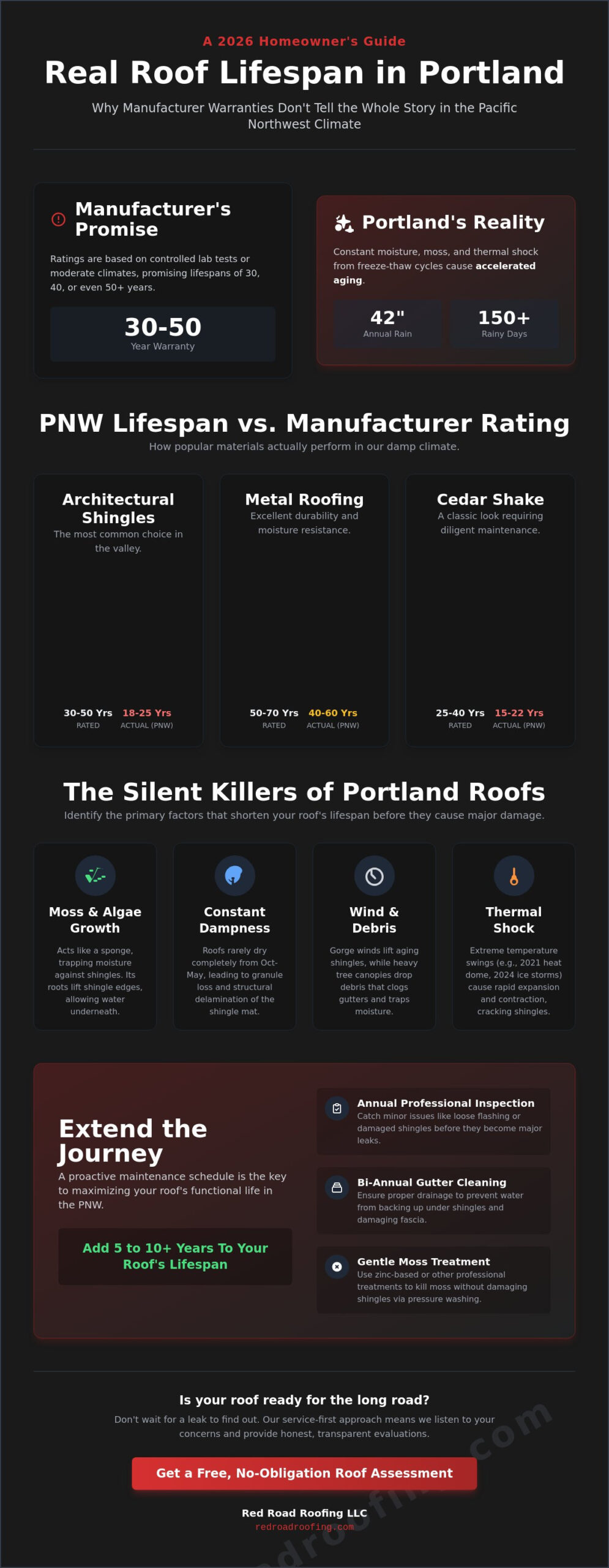
When we discuss roof life expectancy portland homeowners often look for a specific expiration date stamped on their shingles. In reality, a roof’s lifespan is a flexible performance window rather than a fixed deadline. While manufacturers provide baseline ratings for commercially available roofing materials, these numbers rarely reflect the reality of the Pacific Northwest. National standards are often tested in controlled environments or moderate climates that don’t see our 150 plus days of measurable precipitation every year.
Portland roofs endure a process known as accelerated aging. This happens because our shingles rarely get the chance to fully dry out between October and May. Prolonged dampness combined with limited UV exposure creates a breeding ground for biological growth that eats away at the asphalt mat. You can’t compare a 30 year shingle in the Arizona desert to one in Multnomah County. The dry heat of the southwest ages a roof through UV brittleness, but our constant moisture cycle causes structural delamination and granule loss much sooner than the brochure suggests.
The Impact of Portland Micro-Climates
Your specific neighborhood in the metro area dictates how hard your roof has to work. We’ve seen that homes nestled in the West Hills face significantly higher moisture retention than those in flatter areas. In Beaverton and Lake Oswego, the heavy Douglas Fir and Maple tree canopies provide shade that prevents evaporation, which directly promotes aggressive moss growth. Wind driven rain from the Columbia River Gorge regularly hits Gresham and Troutdale with enough force to compromise shingle adhesion and lift aging tabs. Precision and pride in installation are the only things that keep these systems intact when the weather turns aggressive.
Why 2026 is a Turning Point for Older Portland Roofs
As we move into 2026, many local roofing systems are reaching a critical failure point due to the extreme weather volatility of the last five years. The 2021 heat dome, where temperatures hit 116 degrees, followed by the severe ice storms of 2024, created a “thermal shock” effect. This rapid expansion and contraction caused massive granule loss on composition shingles across the valley. If your roof was installed around 2005 or 2010, it has likely endured enough stress to warrant a professional evaluation.
Current Oregon building codes have also evolved, requiring more robust ventilation and flashing standards than what was acceptable twenty years ago. We focus on these details because we believe in building for the long road. Our team approaches every inspection with a service first mindset, listening to your concerns before recommending a path forward. To ensure your home stays protected, consider these factors that influence roof life expectancy portland systems face today:
- Thermal Shock: Extreme temperature swings that crack the shingle’s internal mat.
- Drainage Efficiency: How quickly your gutter system clears water during a typical Portland downpour.
- Granule Integrity: The amount of protective stone coating remaining to shield the asphalt from the sun.
At Red Road Roofing LLC, we don’t believe in shortcuts. We provide craftsmanship you can trust by understanding that a roof is a complete system, not just a layer of shingles. By recognizing the specific challenges of our local climate, you can make informed decisions that strengthen your home for decades to come.
Lifespan Comparison: Popular Roofing Materials in the PNW
Choosing the right material is the first mile in your home’s journey toward long-term protection. While many manufacturers promise a lifetime of security, the actual roof life expectancy portland homeowners see is often shorter than the numbers printed on the brochure. Our local climate, characterized by 36 inches of annual rainfall and high humidity, puts every shingle and seam to the test. Understanding the gap between marketing claims and Pacific Northwest reality helps you make a choice built for the long road.
We focus on delivering craftsmanship you can trust by prioritizing materials that balance durability with regional performance. Every home has a unique path. Selecting a material that matches your architectural style and maintenance capacity is the best way to ensure your investment stays secure for decades.
Composition and Architectural Shingles
Standard 3-tab composition shingles often carry a 20 or 25-year manufacturer warranty. In Portland, the real-world lifespan is typically 15 to 20 years. The constant moisture encourages moss growth that can lift shingle edges, leading to premature failure. This is why we emphasize composition shingle roofing portland residents can rely on for the best balance of cost and longevity.
Architectural shingles are the gold standard for our region. These thick, laminated shingles offer superior wind resistance and a more dimensional look. They are specifically designed with algae-resistant granules. These copper or zinc-coated particles are essential in Oregon. They prevent the dark streaks and moss buildup that rot underlying structures. When installed with precision and pride, a high-quality architectural roof can reliably protect a home for 25 to 30 years. Homeowners who want even greater longevity and moss resistance may also want to explore synthetic roofing options engineered specifically for Portland’s damp climate.
Metal and Flat Roofing Systems
Metal roofing is a powerhouse for longevity, often lasting 50 years or more. It sheds snow and rain effortlessly. A common misconception is that metal roofs are noisy during heavy Oregon downpours. When installed over solid decking with modern insulation, they are as quiet as any shingle roof. However, metal requires specific maintenance. Fasteners must be checked every 10 years to ensure seals remain watertight against our persistent drizzle.
For Portland’s modern and mid-century homes with flat or low-slope sections, TPO and PVC systems are the standard. These membranes offer a 20 to 30-year lifespan. They are highly effective at preventing ponding water issues. Many homeowners choose Energy-efficient cool roofs in these categories to reflect UV rays. This choice protects the membrane from heat degradation and lowers cooling costs during our increasingly warm summers. Your roof life expectancy portland depends on these technical details. If you want to see which system fits your property’s needs, you can consult with our craftsmen for a detailed evaluation.
The Silent Killers: Why Portland Roofs Fail Early
In the Pacific Northwest, a roof’s worst enemy isn’t always a massive windstorm. It’s often the slow, green creep of moss. While many homeowners view a mossy roof as a classic PNW aesthetic, it’s actually the primary factor that reduces the roof life expectancy portland residents expect from their investment. Moss acts like a biological sponge, holding moisture against the shingle surface for weeks after the rain stops. This constant dampness is a recipe for premature failure.
This moisture creates a “wicking” effect. As moss clumps grow, they physically lift the edges of shingles. This allows water to travel upward and underneath the primary barrier, reaching the nails and the plywood deck. Once water reaches the underlayment, the transition from a cosmetic issue to structural rot begins. We see this daily in our inspections; a roof that looks “charming” from the street is often rotting from the bottom up. We take pride in identifying these issues before they require a total tear-off.
The Science of Moss and Algae
Moss doesn’t have traditional roots, but it uses “rhizoids” to anchor itself. These tiny filaments dig deep into the mineral granules of your shingles. As the moss grows and expands, it pulls these granules away, causing premature shedding. This exposes the underlying asphalt to UV rays and heat. A roof that stays wet for 100% of the winter never gets a chance to dry out, which accelerates the decay of the organic materials inside the shingle.
Don’t fall for the “quick fix” of a high-pressure power washer. Blasting shingles with 3,000 PSI of water strips away the protective granules entirely. You might remove the green, but you’ll also remove 5 to 10 years of the roof’s functional life in a single afternoon. Precision and pride in maintenance mean using gentle, manufacturer-approved treatments that kill the moss without destroying the shingle’s integrity. For homeowners who are tired of the recurring moss battle, synthetic roofing materials offer a naturally moss-resistant alternative worth considering.
Ventilation: The Breathable Roof
If moss kills from the top, poor ventilation destroys from below. During Portland’s humid summers, attic temperatures can soar above 150 degrees Fahrenheit if heat is trapped. This effectively “cooks” the shingles from the inside out, making them brittle, curled, and prone to cracking. A roof needs to breathe to stay flexible and durable for the long road ahead.
- Balanced Intake: Soffit vents must remain clear of insulation to allow cool air to enter.
- Balanced Exhaust: Ridge vents or gable vents must allow hot, moist air to escape.
- Moisture Control: Proper airflow prevents condensation that leads to mold on the attic rafters.
Proper airflow prevents the formation of ice dams during rare but damaging Portland snow events by keeping the roof deck at a consistent temperature. When a roof is built right and vented correctly, it protects your home’s structural health and ensures you get every year of service possible from your materials. We believe in craftsmanship you can trust, which starts with a roof system that works in harmony with your home’s internal climate.
Warning Signs: Is Your Roof Reaching the End of the Road?
Your home often speaks before it fails. Understanding these signals is the difference between a minor maintenance task and a catastrophic structural emergency. We believe in listening first. Before we suggest a solution, we take the time to listen to what your home is telling us through its physical condition. The roof life expectancy portland homeowners anticipate is often cut short because small warnings are ignored during our wet winters.
Exterior Red Flags
Start your assessment from the ground with a pair of binoculars. Look for granule loss, which often appears as “sand” or grit in your gutters. These granules are the primary UV defense for your shingles. When you see bald spots or heavy accumulation in the downspouts, the asphalt core is exposed. Once 20% of the granules are gone, the shingle becomes brittle and loses its ability to shed water.
Pay close attention to the shape of the shingles. Curling, cupping, or “clawing” occurs when the edges turn upward or the centers begin to bulge. This is a sign of extreme age or poor attic ventilation. Additionally, check the flashing around chimneys and skylights. Damaged or rusted flashing accounts for 90% of roof leaks in the Pacific Northwest. If the sealant is cracked or the metal is pulling away, your home is vulnerable to the next storm.
Interior and Attic Evidence
The attic tells the story that the shingles might hide. Grab a flashlight and look for “pancaking” on your insulation. When fiberglass insulation gets wet, it loses its loft and compresses. This indicates a slow, persistent leak that hasn’t reached your ceiling yet. It’s a systemic warning that your underlayment has failed.
- Light gaps: If you see pinpricks of daylight peeking through the roof deck, you have structural gaps that water will eventually find.
- Musty odors: Visible mold on rafters or a damp smell suggests moisture is trapped. Poor ventilation can reduce your roof’s lifespan by 5 to 7 years.
- Dark staining: Streaks on the underside of the plywood mean water is traveling along the nails.
Distinguishing between a repairable issue and a systemic failure is vital. A few shingles lost in a windstorm is a repair. However, if the shingles are so brittle they crack when touched, or if the decking is soft, you’re looking at a full replacement. We take pride in providing transparency during this process so you don’t spend money on “band-aid” fixes for a failing system.
If you live in Beaverton, Hillsboro, or Tigard and your roof is over 15 years old, it’s time for a professional eyes-on assessment. Precision and pride are the hallmarks of our inspections. We help you plan for the long road ahead so you aren’t caught off guard by a sudden leak.
Schedule a professional inspection with Red Road Roofing LLC today.
Extending the Journey: Maintenance for the Long Road
A roof isn’t a “set it and forget it” feature of your home. In the Pacific Northwest, the elements are relentless, and your roof life expectancy portland depends heavily on the care it receives after the initial installation. Consistent, professional maintenance can add 5 to 10 years to a roof’s functional life. This proactive approach transforms a standard 20-year asphalt shingle system into a 30-year asset, protecting your investment and providing peace of mind through every rainy season. At Red Road Roofing, we believe in the “Master Craftsman” philosophy. This means we don’t just fix leaks; we preserve structures through precision and pride.
The Portland Maintenance Schedule
Portland’s unique climate requires a specialized strategy to combat moisture and organic growth. Follow this three-step rhythm to keep your system healthy:
- Step 1: Annual gutter cleaning. Do this every autumn after the leaves fall. Clogged gutters cause water to back up under the eave shingles, which quickly rots the roof deck and fascia boards.
- Step 2: Bi-annual debris removal. Douglas fir needles and maple leaves trap moisture against the shingles. Removing this organic matter twice a year prevents the rot that eats away at protective granules.
- Step 3: Professional moss treatments. Moss is a roof killer in Oregon. We use eco-friendly, non-corrosive solutions that kill moss at the root without damaging the integrity of your shingles or the local environment.
Precision Repairs vs. Full Replacement
Knowing when to repair and when to replace is a matter of transparency and technical expertise. If your roof is less than 15 years old and the damage is localized, a precision repair is often the most responsible choice. However, if more than 25% of the surface shows signs of failure, such as widespread granule loss or brittle shingles, a repair is often just throwing money away. We pride ourselves on listening first, assessing the actual condition of your home, and providing honest recommendations that prioritize your long-term value over a quick sale.
For commercial property managers or those with flat roof systems, restoration coatings offer a powerful alternative to replacement. High-solids silicone or acrylic coatings can seal an entire system, reflecting UV rays and adding a decade of waterproof protection for a fraction of the cost of a full tear-off. It’s an efficient way to strengthen existing structures while minimizing disruption to your daily life or business operations.
Your roof is your home’s first line of defense. Don’t wait for a ceiling stain to take action. Contact Red Road Roofing today for a precision roof assessment and stay covered for the long road.
Securing Your Home for the Long Road Ahead
Portland receives an average of 36 inches of rainfall every year, creating a demanding environment that tests even the most durable materials. Whether you’re managing a 20-year composition system or a 50-year metal roof, proactive maintenance is the only way to ensure your investment reaches its full potential. Understanding your roof life expectancy portland requires looking beyond the manufacturer’s label to the actual conditions of your specific property. Identifying early warning signs like moss accumulation or granule loss today prevents the structural failures of tomorrow.
Red Road Roofing has been locally owned and operated since 2017, bringing a master craftsman’s eye to every project. Our team of Certified Journeyman Craftsmen specializes in PNW-specific composition and metal systems designed to withstand our unique climate. We believe in listening first and building with precision. You deserve a partner who values the longevity of your home as much as you do. Take the first step toward total peace of mind and professional clarity.
Get Your Precision Roof Assessment from Red Road Roofing
Your home is your most valuable asset; we’re here to help you protect it for many years to come.
Frequently Asked Questions
How long does a typical asphalt shingle roof last in Portland?
A standard asphalt shingle roof in Portland typically lasts between 18 and 22 years. While manufacturers often rate products for 30 years, Portland’s 42 inches of annual rainfall and high humidity can accelerate shingle degradation. Choosing high-quality architectural shingles and ensuring proper attic ventilation are the best ways to maximize your roof life expectancy portland. Our journeyman craftsmen focus on these details to ensure your home stays dry for the long road.
Does moss on my roof actually cause damage or is it just ugly?
Moss is a serious structural threat that can shorten a roof’s lifespan by 10 years or more. It acts like a sponge, holding moisture against the shingles and leading to wood rot in the underlying decking. The Asphalt Roofing Manufacturers Association notes that moss roots can actually lift shingles, which allows water to seep into your home. We treat moss as a maintenance priority to preserve the integrity of your full system installation.
Will a metal roof last longer than shingles in the Pacific Northwest?
Metal roofs typically last 40 to 70 years, which is more than double the lifespan of traditional shingles. They’re an excellent choice for the Pacific Northwest because they shed 100% of moisture and naturally resist moss growth. While the initial investment is higher, the long-term value is undeniable. A metal system provides a level of durability and precision that protects your property through decades of winter storms.
How much does a new roof cost in Portland in 2026?
According to the 2024 Remodeling Cost vs. Value Report, a standard asphalt shingle replacement in the Portland metro area averages between $31,000 and $36,000. These figures vary based on your home’s square footage and the specific materials chosen for the project. We believe in total transparency during the bidding process. We listen first to your needs to provide a dependable estimate that reflects current labor and material rates.
Can I install a new roof over my existing shingles to save money?
You can technically install a second layer of shingles, but it’s not a strategy we recommend for long-term reliability. An overlay traps heat, which can reduce the new shingles’ lifespan by up to 40% and may void the manufacturer’s warranty. A full tear-off is the only way to inspect the roof deck for rot. We prioritize craftsmanship that’s built right from the bottom up to ensure your home is covered for the long road.
How often should I have my roof inspected in Multnomah County?
You should schedule a professional roof inspection every 24 months in Multnomah County. This regular cadence allows us to identify small issues like cracked flashing or gutter clogs before they turn into expensive emergency repairs. Consistent maintenance is the most effective way to protect your roof life expectancy portland. Our team takes pride in finding the small details that keep your protective coatings and shingles functioning at peak performance.
Does homeowners insurance cover roof replacement due to old age?
Standard homeowners insurance policies rarely cover roof replacement due to general wear, tear, or old age. Insurance is designed to cover sudden and accidental damage, such as a limb falling during a 50 mph windstorm. It’s vital to check if your policy uses “Replacement Cost” or “Actual Cash Value” for claims. We provide honest assessments to help you understand if your roof’s condition is a result of age or a covered peril.
What is the best time of year to replace a roof in Oregon?
July through September is the ideal window for roof replacement in Oregon due to the consistent dry weather. These months provide the best conditions for shingles to seal properly and allow our crews to work with maximum efficiency. However, we perform installations year-round by monitoring weather windows closely. We take the time to protect your home during the process, ensuring every installation is finished with precision regardless of the season.